
 English
 Spanish
 French
 German
 Italian
 Chinese (Simplified)
 Japanese
 Korean
 Arabic
 Portuguese



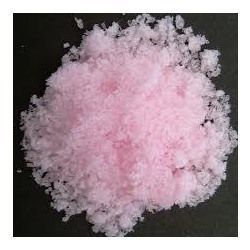
Manganese(II) Chloride
150 INR/Kilograms
Product Details:
- Shape Crystalline solid
- Melting Point 650 °C
- Taste Tasteless
- Purity 98% min
- Smell Odorless
- Other Names Manganese Dichloride, Manganese Chloride
- Boiling point 1190 °C
- Click to view more
X
Manganese(II) Chloride Price And Quantity
- 150 INR/Kilograms
- 50 Kilograms
Manganese(II) Chloride Product Specifications
- Crystalline solid
- Manganese(II) Chloride
- Tasteless
- Industrial, Laboratory
- 650 °C
- Used as a catalyst, laboratory reagent, dietary supplement, dye intermediates, production of manganese compounds
- Technical, Laboratory
- Manganese(II) Chloride
- Odorless
- 98% min
- Halide, Inorganic Compound
- Inorganic Salt
- Soluble in water, ethanol, and methanol
- 2.98 Gram per cubic centimeter(g/cm3)
- Powder, crystalline
- MnCl2
- Keep tightly sealed; store in a cool, dry place
- ~4 (1% solution)
- 28273990
- Manganese Dichloride, Manganese Chloride
- 1190 °C
- 125.84 g/mol
- Pale pink solid
- Stable under normal conditions
- 24 months under recommended storage
- Irritant to eyes and skin
- Very soluble
- ISO 9001:2015 approved manufacturer
- 25 kg HDPE bags / fibre drums
Manganese(II) Chloride Trade Information
- 3000 Kilograms Per Day
- 7 Days
Product Description
Manganese Chloride
Specifications
|
Synonym |
MANGANOUS CHLORIDE, MANGANESE DICHLORIDE |
|
Cas No. |
13446-34-9 |
|
Molecular Formula |
MnCl2.4H2O |
|
Molecular Weight |
197.91 |
|
Description |
LARGE, IRREGULAR, PINK, TRANSLUCENT CRYSTALS |
|
SOLUBILITY |
FREELY SOLUBLE IN WATER |
|
IDENTIFICATION |
MANGANESE & CHLORIDE = +VE |
|
INSOLUBLE MATTER |
MAX.0.005% |
|
IRON |
MAX. 0.0005% |
|
LEAD |
MAX. 0.0004% |
|
PH OF 5% SOLUTION |
4.0 - 6.0 |
|
SUBSTANCES NOT PRECIPITATED BY SULFIDE |
MAX. 0.2% AFTER IGNITION |
|
SULPHATE |
MAX. 0.005% |
|
ASSAY |
98.0-102.0% OF MNCL2.4H2O |
Versatile Applications
Manganese(II) Chloride serves diverse roles in industrial and laboratory settings. Its primary applications include acting as a catalyst in chemical reactions, serving as a laboratory reagent, nutritional supplement, and as an essential intermediate in dye manufacturing and the synthesis of other manganese-based compounds.
Quality and Stability Assured
This product boasts a purity of minimum 98%, supplied in a crystalline or powdered form. With a shelf life of up to 24 months when stored properly in cool, dry, and sealed containers, its stability under standard conditions ensures reliable performance for prolonged periods.
Safe Handling and Storage
While Manganese(II) Chloride is stable, it can irritate the eyes and skin upon contact. It is crucial to handle with appropriate personal protective equipment. Always store the chemical in tightly sealed containers, away from moisture, in cool and dry environments to maintain product quality.
FAQs of Manganese(II) Chloride:
Q: How should Manganese(II) Chloride be stored to ensure maximum shelf life?
A: Manganese(II) Chloride should be kept tightly sealed in a cool, dry place away from direct sunlight and moisture to maintain its stability and achieve the full 24-month shelf life.Q: What are the main industrial and laboratory uses of Manganese(II) Chloride?
A: This compound is widely used as a catalyst in chemical processes, as a reagent in laboratories, in the synthesis of dyes and manganese compounds, and as a dietary supplement in trace amounts.Q: When does Manganese(II) Chloride become hazardous and how can risks be minimized?
A: It poses hazards primarily when in contact with skin or eyes, as it is an irritant. Risks can be minimized by wearing gloves, goggles, and ensuring proper ventilation when handling the substance.Q: Where is Manganese(II) Chloride manufactured and supplied from?
A: It is manufactured by ISO 9001:2015 approved producers in India and is exported, distributed, and traded globally in 25 kg HDPE bags or fibre drums.Q: What is the typical process for using Manganese(II) Chloride in laboratory experiments?
A: In laboratories, measured amounts of Manganese(II) Chloride are dissolved in water or suitable solvents. Its solutions are then used for various analytical procedures or as a reagent in chemical syntheses.Q: How does the solubility of Manganese(II) Chloride benefit its applications?
A: Its high solubility in water, ethanol, and methanol allows for easy preparation of solutions and facilitates its use as a catalyst and reagent in highly controlled chemical reactions.Tell us about your requirement

Price:
Quantity
Select Unit
- 50
- 100
- 200
- 250
- 500
- 1000+
Additional detail
Mobile number
Email

Other Products in 'Inorganic Chemical Compound' category



Contact Details
- Survey No 258/1, Opp. Raj Ind Estate, Samlaya Road, Karchiya,Vadodara - 391520, Gujarat, India
- oasisfinechem1@yahoo.in
 Send Inquiry
- Phone :91--7984442810



 |
OASIS FINE CHEM
All Rights Reserved.(Terms of Use) Developed and Managed by Infocom Network Private Limited. |
